

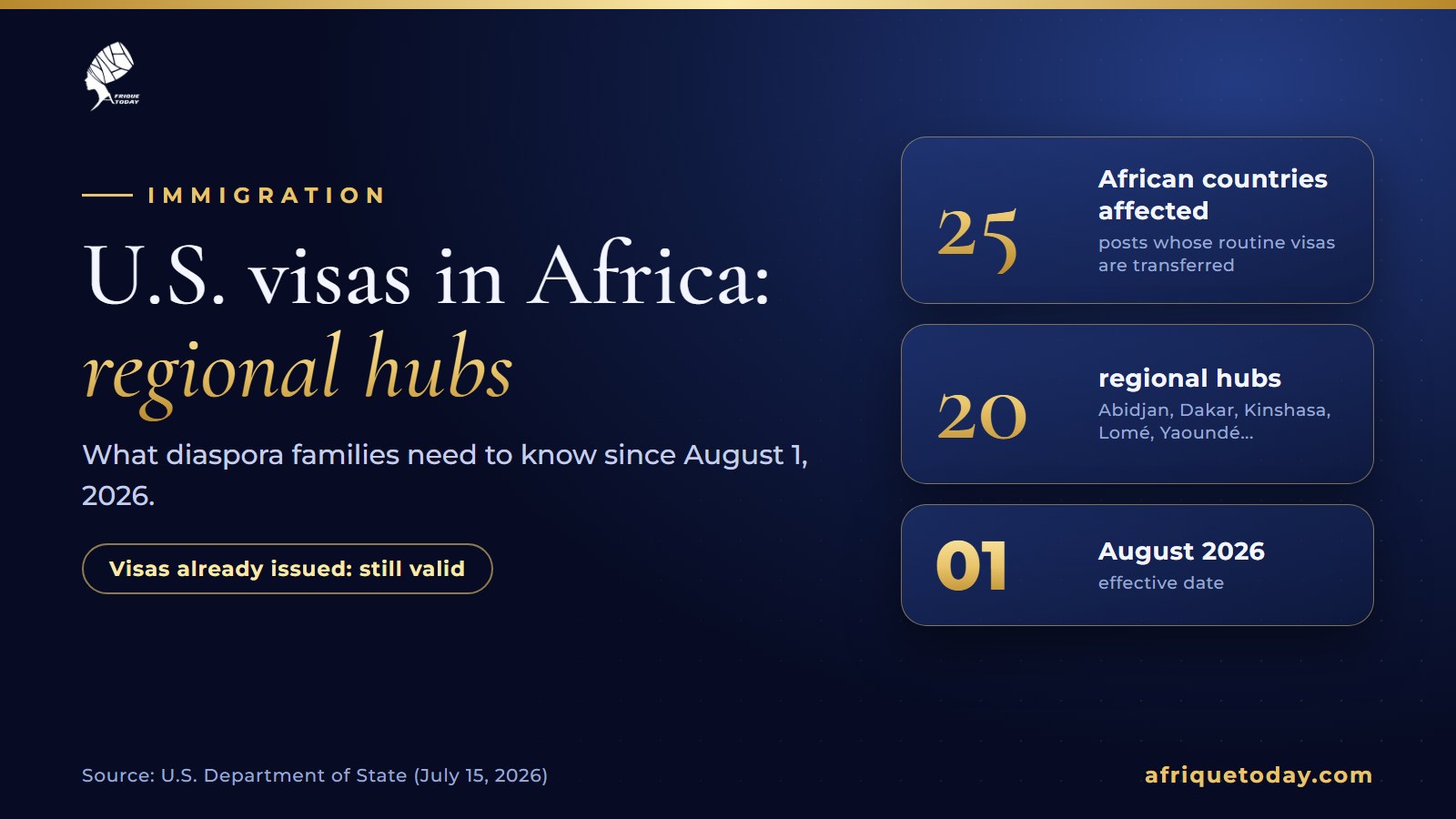
Since August 1, 2026, routine U.S. visa applications are no longer handled at the local embassy in 25 African countries but at a regional hub. The State Department announcement, updated July 15, 2026, affects many diaspora families whose relatives are applying for a visa. Here is what to know, based on the official State Department page.
What changes
- Routine visa services at 25 posts have moved to regional hubs since August 1, 2026.
- Citizens and residents of these countries who apply for a visa on or after that date must schedule an appointment and pay the visa fee at the designated nonimmigrant or immigrant visa location.
- The State Department presents the move as a long-standing practice meant to promote more uniform screening, vetting and adjudication standards and to improve efficiency.
The 25 affected posts
Antananarivo, Abuja, Asmara, Bamako, Banjul, Brazzaville, Bujumbura, Conakry, Cotonou, Durban, Freetown, Gaborone, Harare, Juba, Libreville, Lilongwe, Lusaka, Maputo, Maseru, Mbabane, N’Djamena, Niamey, Nouakchott, Ouagadougou and Windhoek. Francophone countries are in bold.
The 20 regional hubs
Routine visa services are provided at the U.S. embassies and consulates in Abidjan, Accra, Addis Ababa, Cape Town, Dakar, Dar es Salaam, Djibouti, Johannesburg, Kampala, Kigali, Kinshasa, Lagos, Lomé, Luanda, Malabo, Monrovia, Nairobi, Port Louis, Praia and Yaoundé.
Please note: the official page does not say which hub serves which country. It only says to use the designated visa location. Check the website of the U.S. embassy in your relative’s country to find yours.
Which visas are affected?
- All routine visas: nonimmigrant visas (tourist, business and petition-based) and immigrant visas.
- For immigrant visas: immediate relatives (IR), family preference (FP), employment-based (EB), fiancé(e) (K), adoptions, Diversity Visas and certain follow-to-join refugee and asylee cases (V92/V93).
- Immigrant visa applicants can complete their medical exam in their home country if a panel physician is available there, or at the designated hub.
What does not change
- Currently valid visas are not affected.
- No embassy or consulate is closing: the realignment does not change their operating status. The 25 posts keep American Citizen Services (ACS) and limited nonimmigrant visa services. Bangui offers emergency ACS only, and there are no consular operations in Bangui or Khartoum.
- Existing restrictions remain in place: visa suspensions under Presidential Proclamation 10998, visa bond requirements and immigrant visa pauses for certain nationalities.
What to do if a relative is affected
- Already have an appointment at an affected post? Watch your email: the State Department says it will send specific guidance for applicants in each country.
- Already paid the visa (MRV) fee? The official page said applicants had to schedule an appointment by July 31, 2026 at the post where the fee was paid; without one by that date, the fee is not refunded.
- Read the official page and the website of the U.S. embassy in the country concerned. For a specific case, ask an immigration attorney. This article is informational and is not legal advice.
Why it matters for the diaspora
Many DMV diaspora families bring relatives to the United States for visits, studies, a wedding or a residency application. For nationals of countries such as Mali, Congo, Guinea, Benin, Gabon, Chad, Niger, Mauritania or Burkina Faso, the appointment is now held in another country, which can change timelines, travel costs and trip planning. It is better to get informed early.
Source
This article is our own summary. Official source: U.S. Department of State, “Realignment of U.S. Visa Services in Africa to Regional Hubs”, last updated July 15, 2026.