

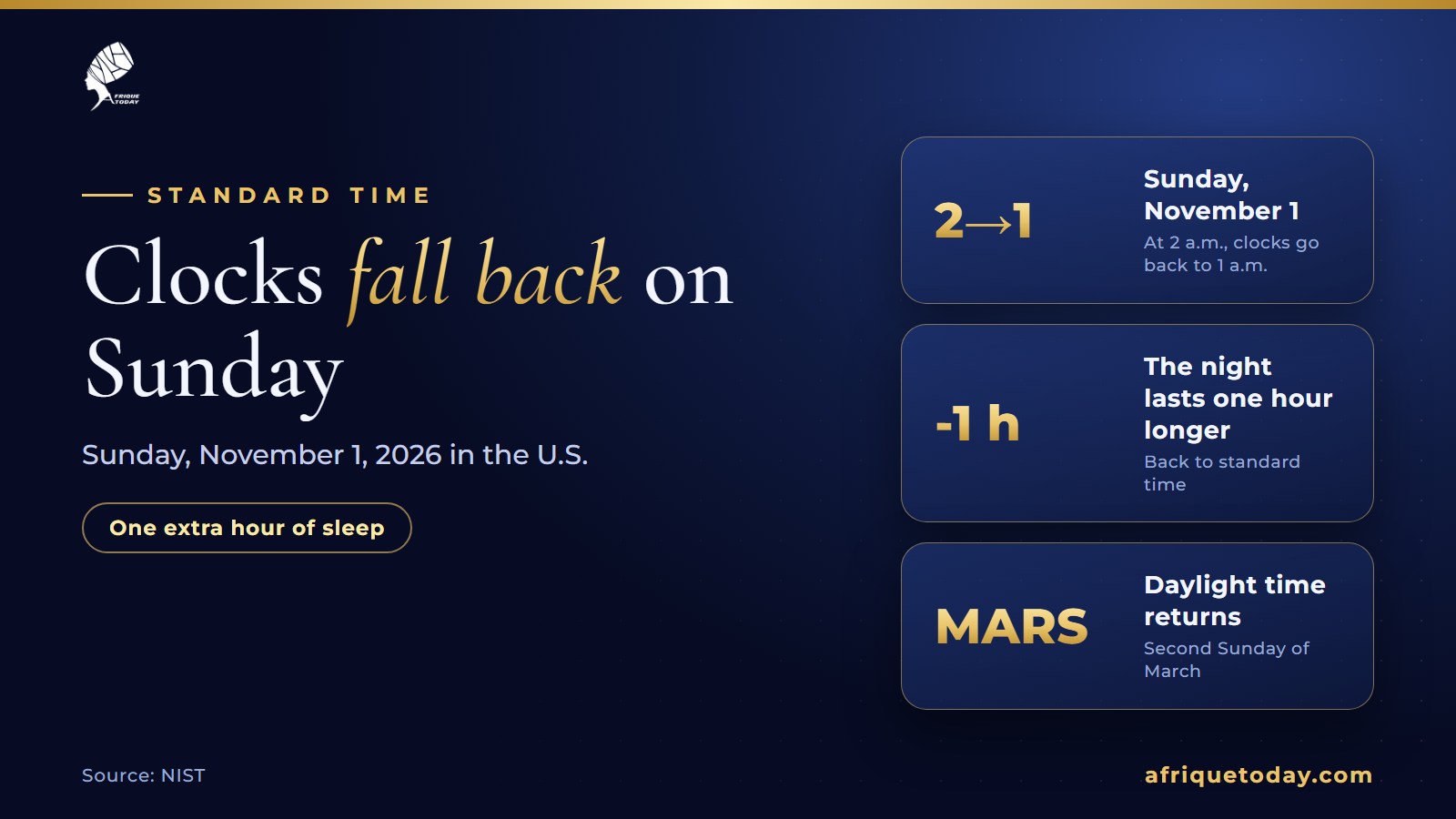
At 2 a.m. on Sunday, November 1, 2026, clocks in the United States fall back one hour: it becomes 1 a.m. This is the return to standard time, and the night lasts one hour longer. Here is what to know, according to NIST, the U.S. National Institute of Standards and Technology.
What changes
- When: Sunday, November 1, 2026, at 2 a.m. local time.
- What: local time becomes 1 a.m. again, and that hour is repeated.
- For you: remember to set clocks, watches and alarms that do not update on their own.
The rule
According to NIST, daylight saving time begins at 2 a.m. on the second Sunday of March and ends at 2 a.m. on the first Sunday of November. This rule has been in effect since 2007, after the Energy Policy Act of 2005 lengthened the period by about a month.
Who does not change the clock
NIST says Hawaii, American Samoa, Guam, Puerto Rico, the U.S. Virgin Islands and Arizona do not observe daylight saving time. The exception is the Navajo Indian Reservation, which does.
When calling relatives in Africa
Countries that do not change their clocks stay the same, but Washington time moves back. The time difference with your relatives therefore changes by one hour: check the local time before calling.
This article is informational.
Sources
This article is our own summary. Official sources : NIST, Daylight Saving Time (DST).